
Helical and push piers for Springfield foundation repair both run $1,200–$3,000 per pier — and shallow Plateau limestone often means fewer sections per pier. Push piers drive to logged refusal under heavier masonry; helicals torque to measured capacity for light frame and additions.
How each proves capacity, and what shallow bedrock does to the choice and the bill.
Two proofs of the same promise
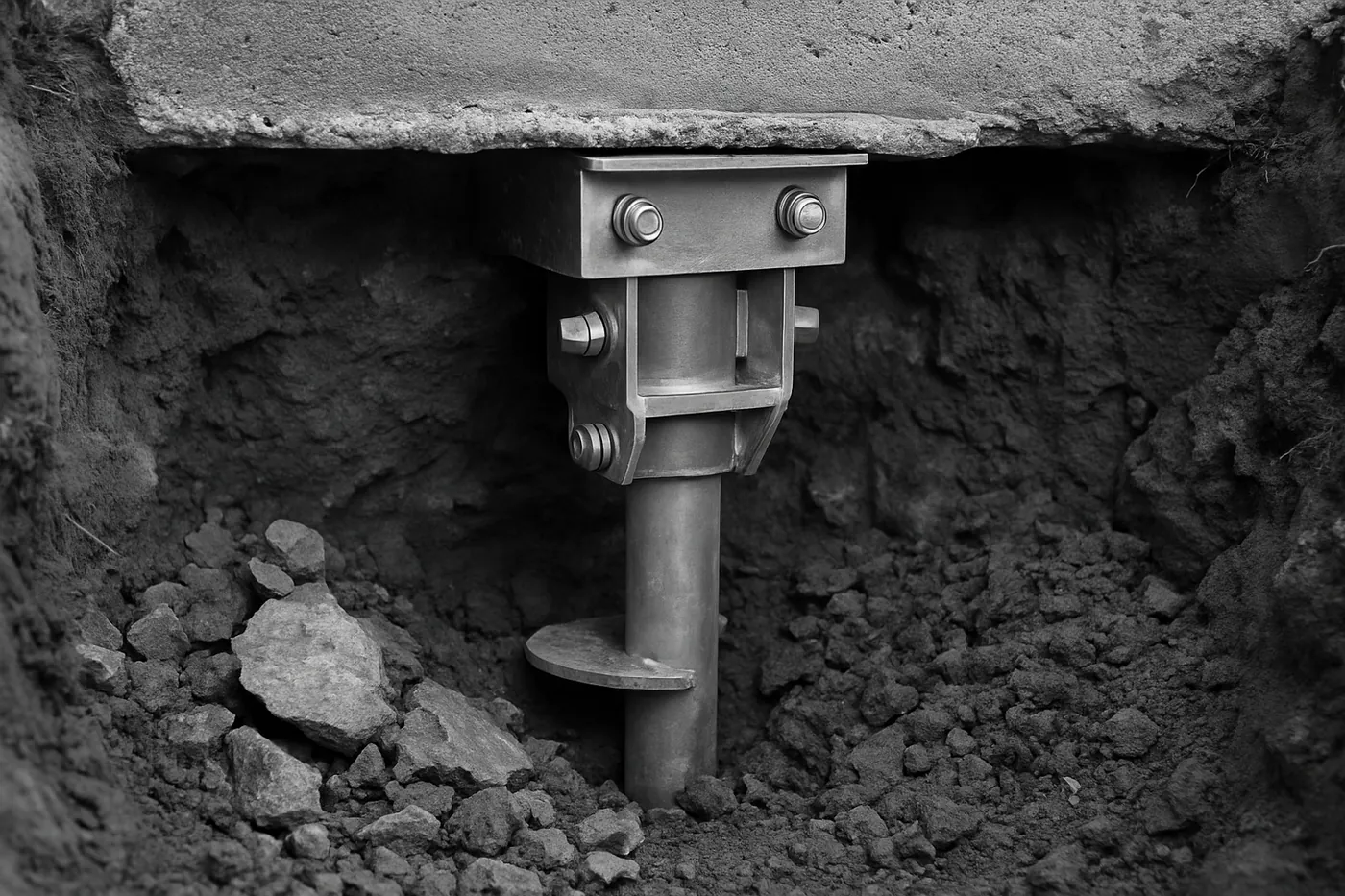
A pier here carries the footing through the thin active clay to something that holds — often the Mississippian limestone itself. A push pier is hydraulic steel driven beside the footing using the structure as reaction weight until it refuses; the logged refusal is the proof. A helical pier screws in on welded plates, its installation torque correlating with capacity — the gauge proves it as it turns, independent of the house above. Same promise, two receipts.
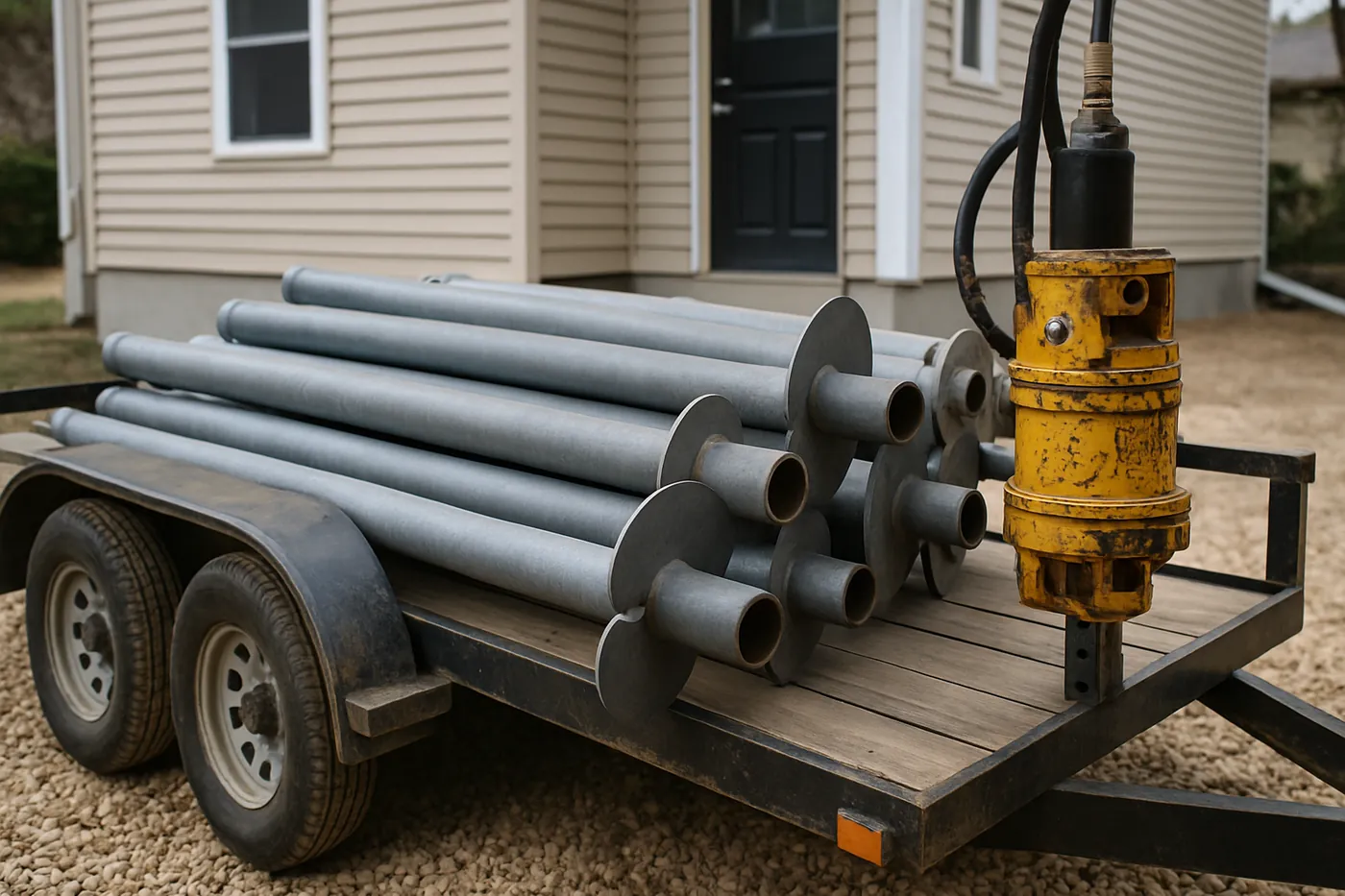
Side by side
| Push piers | Helical piers | |
|---|---|---|
| Advance | Driven against the structure’s weight | Rotated to specified torque |
| Proof | Refusal pressure, logged per pier | Installation torque, logged per pier |
| Needs house weight | Yes | No |
| Springfield fit | Older brick and stone near the core | Frame ranches in Nixa, Republic, Willard; porches |
| Shallow-rock behavior | Early refusal — verified, then welcomed | Torque spike — verified, then welcomed |
| Cost | $1,200–$3,000 per pier; fewer sections when rock is close | |
The Plateau’s pier arithmetic
Depth drives pier pricing everywhere, and Springfield’s geology tilts it kindly: with bedrock shallow across much of the metro, piers reach competent bearing in fewer sections, and the spread inside the $1,200–$3,000 range leans low more often than in deep-clay country. The discipline that keeps it honest is verification — shallow refusal must prove rock, not a boulder, and one odd log among consistent neighbors is how a floater announces itself. Where the settlement diagnosis has raised any karst flag, engineering review precedes steel: load transferred downward requires downward to be sound, and Greene County’s geology has earned that respect in code. Install mechanics live on the piering page; the arithmetic is in the cost guide.
Reading a Springfield pier bid
Ask three things of every bid, ours included: per-pier proof logging, the depth assumption and price behavior beyond it, and how shallow anomalies get verified before they’re called bearing. On this ground the third question separates the crews who know the Plateau from the ones who’ve only priced it. Honest answers converge; the numbers they converge to are in the cost guide.
What the pier warranty is actually worth
Read the warranty before the price. It covers the piers’ capacity — the supported section carrying its design load — not the whole house, and not the parts nobody piered. Four questions separate a real warranty from a brochure: is it transferable to the next owner, does a transfer cost a fee, does it cover the piered section or the structure, and does it survive the contractor closing its doors (third-party-backed warranties do). On karst, ask a fifth and get it in writing: what happens if a void opens near the piered area later. Thin residual soil over limestone is exactly where that question stops being hypothetical, and the depth log is the record that answers it.
Pier questions, straight answers
Does shallow bedrock make piers cheaper in Springfield?
Often, yes — and it's the honest local advantage. Both pier types price at $1,200 to $3,000 each, with depth driving the spread; on the Plateau, competent limestone frequently answers in fewer sections than deep-soil metros burn. The care point is proof: the log must show genuine bearing on rock, not a ledge or boulder, and that's exactly what per-pier logging is for.
Which type fits which Springfield houses?
Weight decides. The brick and stone stock near the city core carries reaction mass enough to drive push piers to convincing refusal. The one-story frame ranches filling Nixa, Republic, and Willard commonly can't — the house runs out of weight before refusal convinces — so helicals prove those by torque. Porches and additions are helical candidates everywhere.
What happens when a pier hits rock almost immediately?
It gets verified, not celebrated. Very shallow refusal can mean competent bedrock — or a boulder, a ledge, or debris fill. Drive behavior distinguishes them: rock answers consistently across piers, while a floater shows up as one odd log among honest neighbors. Where karst has been flagged on a lot, shallow anomalies get engineering review before anyone calls them bearing.
Do piers make sense near a mapped sinkhole?
Not until a geologist or engineer has read the ground. Springfield's own code requires sinkhole mapping before construction on affected lots, and repair deserves the same discipline: piers transfer load downward, and downward has to be sound. Where records or symptoms raise the question, we flag it and the engineering happens first — steel into raveling ground helps no one.
What documentation comes with the installation?
A per-pier log — refusal pressure or final torque — plus a transferable warranty. On the Plateau the log matters doubly, because it's also the record that bearing was verified rock-solid rather than assumed. Buyers' inspectors here know the county's geology; 'engineered, logged, warrantied' is worth real money at resale.
Get a free Springfield foundation evaluation
Tell us what the house is doing — cracks, sinking corners, doors gone stubborn, water where it shouldn’t be — and we'll schedule an evaluation with photos and crack measurements. We reply the same business day.