
Foundation settlement repair in Springfield runs $3,800–$12,500 for most homes, with piers at $1,200–$3,000 each placed where an elevation survey shows the footing dropped. The Plateau’s thin residual soils over limestone settle by ordinary clay mechanics — and Greene County’s karst is checked, not assumed away.
Settlement on thin soils, the sinkhole check, and what repair involves.
How thin soil settles
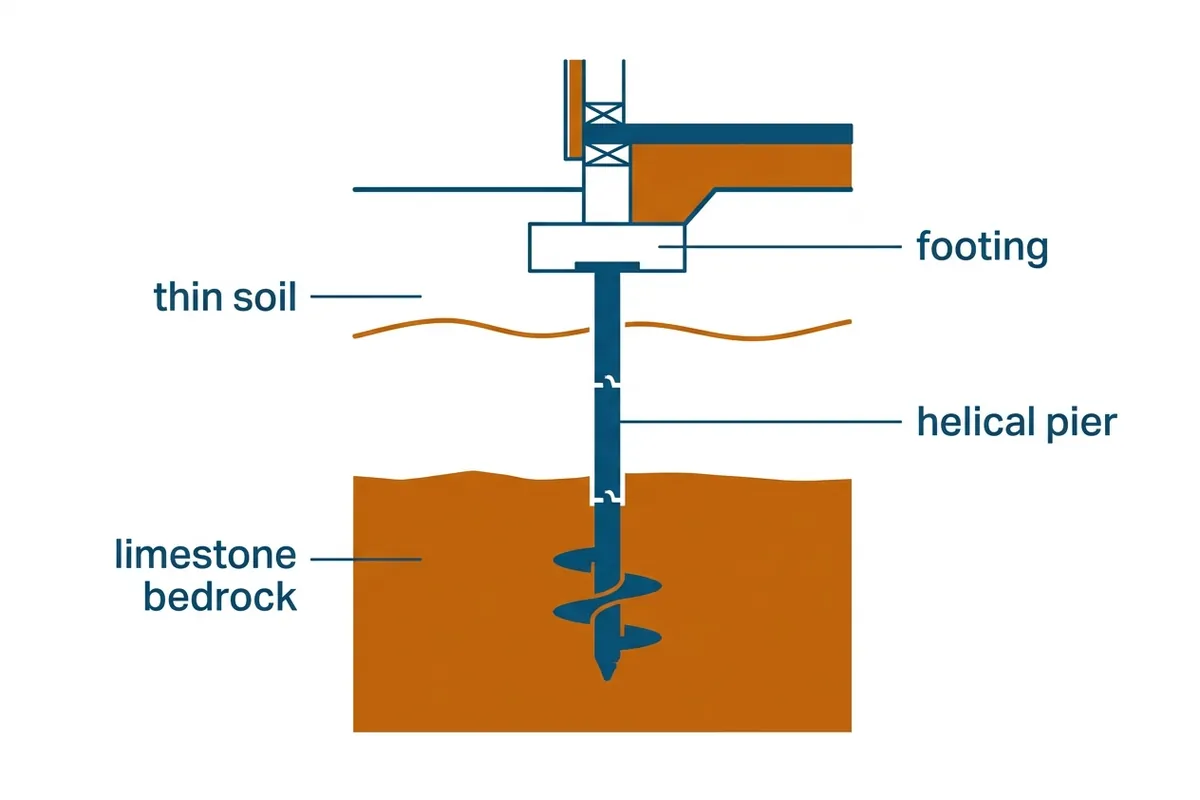
Springfield sits on the Springfield Plateau: a modest thickness of residual clay over Mississippian limestone. That geometry shapes the local version of settlement. The clay that exists lives at the surface, where wet springs and dry summers work it directly, so moisture swings show up in the house quickly — sticking doors, stair-step cracks in brick veneer, a corner easing down over a season. But with bedrock close, total displacements tend smaller than deep-clay markets suffer, and repairs correspondingly shorter. The pattern is the usual one: south and west exposures dry first, downspout corners cycle hardest, and differential movement — one run down, the rest holding — is what racks the frame and prices the fix.
The karst check — respect, not alarm
Greene County documents roughly 8,000 sinkholes, and Springfield’s development code takes the geology seriously enough that a visible sinkhole on a lot must be mapped by a geologist before building there. For settlement diagnosis, that history earns one honest step: before we attribute odd movement to clay, we check the movement’s pattern and the county’s records. Seasonal, directional movement over a footing run is soil. Movement that progresses regardless of weather, pairs with a yard depression, or sits near a mapped feature gets flagged for independent geotechnical eyes before any repair is designed — because steel placed over raveling ground is money buried. Nearly all calls resolve to ordinary soil work. The check is how we earn the “nearly.”
Reading the signs on the Plateau
| Observation | Points toward soil | Points toward karst |
|---|---|---|
| Timing | Tracks seasons — dry-summer worst | Progresses regardless of weather |
| Location | One footing run, sun or downspout side | Concentrated, sometimes mid-footprint |
| Yard | Normal | Depression, soft zone, or a mapped feature nearby |
| County database | No features near the lot | Mapped sinkhole in the vicinity |
| First move | Elevation survey, drainage walk | Survey plus records check, then engineering review |
How the repair works
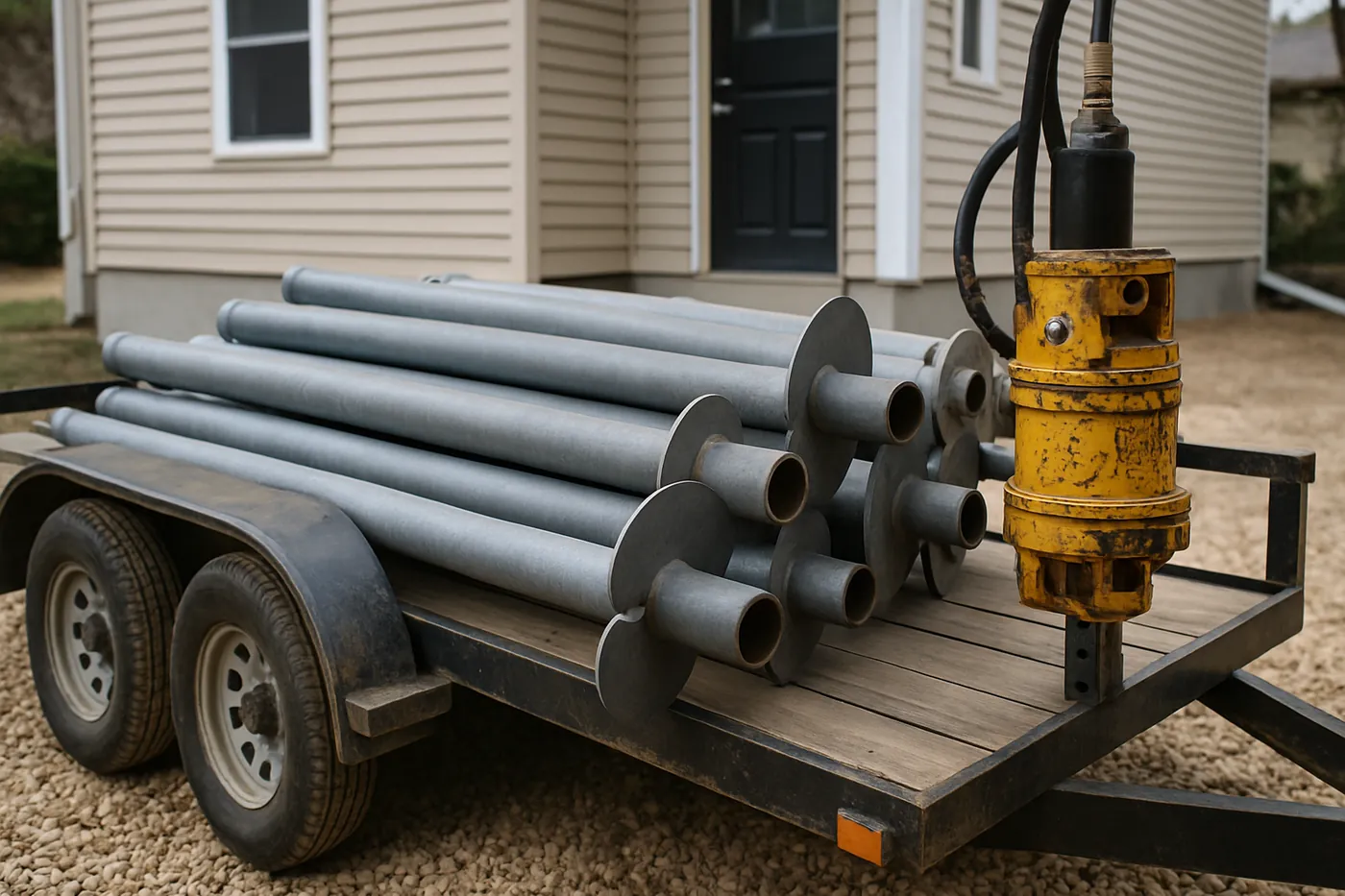
For soil settlement — the overwhelming case — steel piers carry the footing through the thin active clay to bearing, and here that bearing is often the limestone itself: piers reach competent rock in fewer sections than deep-soil metros need, which favors your budget. Each pier is logged; mechanics live on the piering page, and the steel choice on the helical-versus-push page. Because thin soils saturate fast, scopes here lean hard on the water: drainage and waterproofing to stop the cycle, crack repair once movement is resolved. The cost guide itemizes every range.
The first year after the piers
Piers stop the movement; they don’t erase its history. Give the house a full wet-and-dry cycle before chasing cosmetics, then patch drywall and re-point once instead of twice. Monitoring is free: a dated photo and a pencil line across each crack answers “did it move?” in seconds. On the Springfield Plateau, add one habit the rest of the fleet doesn’t need — walk the yard after heavy rain and look for new depressions, ponding that drains away oddly fast, or soil pulling away from the foundation. In a county with roughly 8,000 documented sinkholes, those are the surface signs of a void story, and catching one early is the difference between drainage work and a geologist’s scope.
Settlement questions, straight answers
How likely is it that my settlement is sinkhole-related?
Statistically unlikely, locally checkable. Greene County documents roughly 8,000 sinkholes, but most settlement calls here are still ordinary soil mechanics — thin residual clay wetting and drying over shallow rock. The checkable part: movement that ignores seasons, yard depressions, or a mapped feature nearby raises the karst question, and the county's own sinkhole database is one of the first things we consult.
What does settlement look like on the Plateau's thin soils?
Faster to show, smaller to fix — usually. With bedrock shallow, there's less soil column to move, so seasonal swings translate to smaller total displacements than deep-clay markets see. The flip side: what soil exists sits right at the surface where weather works it hardest, and a drainage fault concentrates the damage quickly. Stair-step cracks and sticking doors arrive early and honest.
Does the county sinkhole database really matter for a repair?
The county sinkhole database really does matter, twice. Before diagnosis, a mapped feature near your lot changes how we read odd movement. Before certain projects, it matters legally: Springfield's development code requires a geologist to map a visible sinkhole's boundaries before building on the lot. A repair scope isn't new construction, but the same geology deserves the same respect — and the same records check.
Can drainage fixes stop settlement without piers here?
Often, if caught early — and drainage matters double on karst. Thin soils saturate fast, and concentrated roof water doesn't just soften bearing; over limestone it's also the mechanism that moves fines into voids. Downspouts, grading, and discharge routing are cheap and genuinely preventive here. Once elevations show real displacement, piers do the lifting.
What does settlement repair cost in Springfield?
Most structural repairs run $3,800 to $12,500, with piers at $1,200 to $3,000 each. Shallow bedrock often works in your favor — piers reach competent limestone in fewer sections than deep-soil markets need, trimming per-pier cost toward the low end. The written scope prices each location, and any karst flag is resolved before steel is ordered.
Get a free Springfield foundation evaluation
Tell us what the house is doing — cracks, sinking corners, doors gone stubborn, water where it shouldn’t be — and we'll schedule an evaluation with photos and crack measurements. We reply the same business day.